Thursday, December 7, 2017
Title: Matilda: The Algonquin Cat
Author: Leslie Martini
Genre: picture books, cat books, cat storytime, based on a true story, NYC history
I first read about Matilda a few weeks in a back issue of Catster magazine during one of my cats' vet appointments. A cat that lives in a hotel? I was intrigued. After some research I discovered this book; my son loves cats and I can still get away with reading picture books to him, so I ordered the book through my library's interlibrary loan program. The book is adorable and as an added bonus (for me), my son took the initiative, with no prompting or begging from me, to read this book aloud on his own. This book chronicles the daily duties and thoughts of our precious Matilda with plenty of cat-itude!
Unfortunately, Matilda passed away this past October due to complications from a stroke. But fear not- a feline still graces the hallway of the famed Algonquin- Hamlet! You can read more about Hamlet here (and book a hotel room): http://www.algonquinhotel.com/story/algonquin-cat/
Sunday, October 29, 2017
Black and Blue
Title: Black and Blue: Inside the Divide Between the Police and Black America
Author: Jeff Pegues
Genre: nonfiction, American history, racism, civil rights, African American history
**This review has been adapted from a book review I wrote for my Anthropology and Pop Culture class**
The
beating of Rodney King was one of the most infamous police brutality cases of
the twentieth century. Police brutality cases involving African American men
appear to be on the rise in recent years- between 2014 and 2017, Laquan
McDonald, Freddie Gray, Eric Garner, Alton Sterling, Keith Lamont Scott, Tamir
Rice, Michael Brown, Walter Scott, Philando Castile, and Terrence Crutcher died
during police interactions or while in police custody. Jeff Pegues, in Black and Blue: Inside the Divide Between
the Police and Black America, brings
to light why police brutality is once again making headlines throughout
America: the roots of racism in police brutality, the lack of accountability in
policing, and the need for reconciliation between the police and the African
American community.
The
first theme that Pegues tackles in his book is accountability. Members of the
police and African American communities were interviewed by Pegues about their
thoughts on police accountability. Both sides agreed that police need to be
held accountable and punished when they overstep their bounds but each side
measured that accountability in different ways. Achieving accountability was on
the minds of many Chicagoans after the police shooting death of Laquan McDonald
in 2014. After the shooting, the Chicago Police Department (CPD) originally
released a statement that the shooting was justified after McDonald had acted
in an aggressive manner; when the video was released to the public thirteen
months later, the video revealed that “Van Dyke fired the first sixteen shots,
and Laquan McDonald was leaning away from the officer. The CPD’s so-called code
of silence had been exposed along with other systemic problems going back
decades” (Pegues 2017:63).
What
is the “code of silence’? It depends on whom Pegues interviewed. Mayor Rahm
Emanuel described the code of silence as “the tendency to ignore. It is the
tendency to deny. It is the tendency [to] in some cases cover up the bad action
of a colleague or colleagues” (Pegues 2017:46). Dean Angelo, a CPD veteran and
president of the Fraternal Order of Police claims the thin blue line “keeps the
beast from the door” and is “the line of separation between the good and the bad”
(Pegues 2017:54). To Angelo the code of silence is not covering a colleague’s
bad behavior but “listening, not talking. Learn by observing, learn by hearing”
(Pegues 2017: 190). The police view the thin blue line and the code of silence
as the noble concepts of protection and duty while the African American
community views it as an “oppressive force” (Pegues 2017:50) of corruption.
In
response to the Laqaun McDonald shooting the CPD established the Police
Accountability Task Force to “actively seek out, listen, and respond to voices
all over this city” (Pegues 2017:63). The Police Accountability Task Force
would also be responsible for the thousands of abuse complaints that are lodged
against the CPD every year: “From 2011 to 2015, 40 percent of complaints
against police officers were not investigated” (Pegues 2017:114). The Task
Force also recommended the creation of the Civilian Office of Police
Accountability- this agency would have “greater power to investigate alleged
police abuse and the use of deadly force…offer recommended changes to both
police policy and procedure” (Pegues 2017:222); Unfortunately, the civilian
task force was a voter-based ordinance which was struck down by voters,
especially voters in white neighborhoods that contained police residents.
The
rejection of the civilian-led accountability agency by white Chicagoans sheds
light on a dirty secret within the police community (and the second theme of
this book): the infiltration of white supremacists in the law enforcement
community. Some of this infiltration manifests itself in obvious ways and
sometimes racial bias within in police ranks is more insidious. In our class
lecture, we learned that some Los Angeles police officers hailed originally
from Mississippi and they brought their racial biases with them to California.
These LAPD officers were known to cruise African American neighborhoods for the
sole purpose of stirring up trouble by yelling racial epithets and acronyms
from their police cruisers (Trunzo class lecture, September 5, 2017). Liberal
San Francisco was no better in their viewpoints towards African Americans- one
police precinct in an African American neighborhood was known to have a picture
of a KKK grand wizard displayed on a public bulletin board (Trunzo class lecture,
September 5, 2017).
An
example of insidious racial bias within law enforcement is the controversial
“stop and frisk” policies initiated by the New York Police Department that were
later adopted throughout the country. The original purpose of stop and frisk
was crime prevention: “officers were encouraged to stop and question
pedestrians and then frisk them for weapons” (Pegues 2017:26) but complaints
and statistics show that this policy was abused by cops with racial motives and
usually only enforced in minority communities. For example, in Baltimore stop
and frisk was “concentrated in predominantly African American neighborhoods and
often lacked reasonable suspicion” (Pegues 2017:22) and
BPD searched African Americans more frequently during
pedestrian and vehicle stops, even though searches of African Americans were less likely to discover contraband.
Indeed, BPD officers found contraband twice as often when searching white
individuals compared to African Americans during vehicle stops and 50 percent
more often during pedestrian stops (Pegues 2017:23).
On paper, this aggressive form of law
enforcement appeared to lower crime but there were other repercussions: the
breakup of families, job loss, increased prison populations, and the temptation
by police departments to turn stop and frisk into a source of revenue.
The
final theme in Black and Blue is
reconciliation which is repeatedly mentioned in the book by Pegues and by many
of his interview subjects. Pegues recognizes that reconciliation will be a long
process and hard work for both sides of the thin blue line. Pegues recommends a
multi-step reconciliation process: acknowledgement, expungement of bad cops,
sessions of open dialogue, and the establishment of positive interactions
between civilians and the police.
“This
divide in the United States between law enforcement and black Americans shows
that our country is still grappling with a troubled past when it comes to race”
(Pegues 2017:99). The “troubled past” this quote refers to are the slave patrols
in the colonial and antebellum periods of U.S. history and the Jim Crow laws
“which set different rules for blacks and whites…based on the theory of white
supremacy” (Pegues 2017:100). Because of hundreds of years of oppressive
regulations, laws, and policing techniques, the African American community not
only distrusts most police departments but has also had to resort
self-protection because they knew help would not be available outside their
community. Chuck Wexler of the Police Executive Research Forum (PERF) points
out that acknowledgment of racial bias must also include racism within the
police ranks, not just racism between police officers and the community (208).
The
cliché “one bad apple spoils the bunch” is also symbolic about bad cops who
ruin the reputation of their own police department and the entire law
enforcement community. The Chicago Police Data Project found that police
officers “with 10 or more complaints- make up about 10% of the force but
receive 30% of all complaints” (Pegues 2017:229). Another way to root out bad
cops is the prevention of bad hires in the first place. Various entities quoted
within this book mentioned that hiring standards for police officers needed to
be increased: stricter psychological testing, increased salaries for police
officers, and continuous training which includes: “bias awareness, crisis
intervention, mental health issues, interpersonal and communication skills”
(Pegues 2017:135) just to name a few, and police departments need to
acknowledge that not every police academy candidate is mentally capable be a
police officer. Local government officials also need to view police as
“critical infrastructure… If we don’t invest in our infrastructure, what
happens? It breaks down” (Pegues 2017:133). Finally, Pegues believes there must
be civil, open dialogue between the police and the local African American
community to build trust with one another. This tenuous trust must be sustained
through continuous positive interactions between African Americans and law enforcement.
Sunday, October 8, 2017
Tastes of Paradise
Title: Tastes of Paradise: A Social History of Spices, Stimulants, and Intoxicants
Author: Wolfgang Schivelbusch
Genre: non-fiction, food and culture, food history, history, European history
**This review has been adapted from a reflective essay I wrote for my Modern World Civilization class**
Spices and stimulants that are commonplace to
twenty-first century Westerners were considered luxury items in medieval times
and the early modern era: pepper, chocolate, tea, coffee, tobacco, and opium. I
was surprised to read in Tastes of
Paradise about the various controversies surrounding most of these items-
who would have thought that chocolate and coffee had negative connotations and
superstitions surrounding them? Even politics and the overall culture of a
country played a part in who was able to enjoy these delicious bits of
happiness.
Spices
were used in medieval times in medicinal preparations and as social clues to
denote a household’s rank in the social hierarchy: “The higher the rank of a
household, the greater its use of spices” (4). In addition to being consumed in
great quantities, spices were given as gifts between members of the nobility
and sometimes used in lieu of cash payments (7). The long journey from India to
Europe increased spices’ monetary value and added to spices’ allure as
“emissaries from a fabled world” (6), especially in a time where very few
Europeans traveled outside of their native homeland. The nobility and elite of
Europe also used spices as a way to separate themselves from their common
subjects- the poor souls who could not afford the expense of spices and whose
status in the social hierarchy could not be “tasted” or shown to others (7).
The use of spices by the European elite paralleled the
elite’s new focus on “style”- clothes, home furnishings, etc.- all of which
were supplied through Arabic traders throughout the Orient. The author compares
the early modern era dependence on Arabic spice trading with the modern Western
world’s dependence on Arab oil in the twentieth and twenty-first centuries (9)-
which brought to my mind the quote: “the more things change, the more they stay
the same. Eventually the middle class in Europe expanded along with the demand
for spices as the expanding middle class tried to emulate their wealthier
contemporaries (10-11). High demand, high tariffs, and high prices along with
increased understanding of sailing technology prompted European explorers (and
their wealthy investors) to search for a direct sea route to India (10-11). By
cutting out the Arabic traders/middlemen, Europeans hoped to decrease the
prices of spices while keeping up with demand on the Continent: “Whoever
controlled pepper would essentially control the purse-strings of a continent”
(11-12).
Views on alcohol in Europe swung from one extreme to the
other from medieval time to the age of encounter. In medieval times alcohol,
especially beer, was consumed daily “as the main source of nourishment for most
central European and northern Europeans (22). Daily consumption started with
beer soup for breakfast and continued throughout the day. Alcoholic beverages
were also heavily consumed during special occasions and holidays. The common
consumption of alcohol mixed with obligatory social drinking rites meant that
intoxication was rampant. Intoxication was considered normalized behavior until
the Protestant Reformation redefined man’s relationship with God and, by
extension, alcohol (31).
While Protestant attitudes towards alcohol were changing,
coffee was becoming readily available as a substitute for alcohol. While
alcohol numbed one to the miseries of life, the caffeine in coffee encouraged
sobriety (35), increased efficiency and energy (39), and was believed to curb
sexual libido (37): “It marked the start of the working day, formally putting
an end to the night’s rest, and making its drinkers alert and cheerful for the
day ahead” (63). Energy and efficiency were core virtues of the Protestant work
ethic, thus, coffee became a popular non-alcoholic beverage in the
Protestant-dominant countries of England and Germany.
While chocolate is a beloved ingredient around the world
now, chocolate was imported from the New World into predominantly Catholic
countries such as Italy and Spain. Chocolate was originally used by the Spanish
clergy as a “fasting drink” (91) during religious holidays but it soon became a
status symbol of the aristocracy (91). When chocolate entered the world of the
aristocracy it was a rich, sumptuous breakfast beverage that “created an
intermediary state between lying down and sitting up” (91). Chocolate was the
antithesis to coffee: it relaxed the body, was high in calories, and believed
to be an aphrodisiac (perhaps that is why chocolate is a traditional
Valentine’s Day gift?) (92). The status of chocolate declined in the nineteenth
century as its popularity rose among the middle class: “The former status drink
of the ancient régime had sunk to
world of women and children. What formerly symbolized power and glory was now
in the hands of those excluded from power and responsibility in middle-class
society” (93).
The Columbian exchange brought tobacco and its new way of
consumption (smoking) to Europe during the Era of Encounter. Originally tobacco
use was referred to as “drinking smoke” or “drinking tobacco” since European
cultures had no point of reference or name for this new recreational habit: “The
analogy with drinking was thus first a conceptual aid for grasping an otherwise
bewildering novelty” (97). The medical view of tobacco was similar to that of
alcohol: it dulled the senses, thought to be an anti-erotic agent, and
first-time use could be an unpleasant experience. Since smoking calmed the
nerves, the rituals around smoking tobacco focused on preparing one’s mental
activity and concentration.
As each smoking process (pipe, cigar, cigarette, etc.)
grew in popularity, the actual time spent on smoking and its accompanying
rituals decreased (111). Schivelbusch theorizes that the modes and amount of
smoking in a society reveal that society’s “standards of tranquility and
concentration” (115) and “demonstrates to what depth the culture is permeated
by nervousness” (129). I thought this was an intriguing correlation. Often
attributed to world events, social factors, or personality traits, anxiety
seems to be at an all-time high in American society. What if American anxiety
levels are so high because Americans are smoking less? If this is true, it is a
terrible trade-off though- smoke now and be calm, die of lung cancer later.
Opium was a commonly prescribed painkiller in the
nineteenth century and used for a variety of mild or easily treatable medical
conditions. Opium was the drug of choice of for poets, artists, and writers
since it infused their artwork and writings with a dreamlike quality. Society
viewed the lone wolf tendencies and mindsets of these artists and writers as
dangerous: “It was the asocial significance attributed by poets to opium and
hashish which first caused them to lose their identity as ordinary household
remedies” (210). Awareness of the negative consequences of addiction due to the
post-war morphine addicts of the various nineteenth century wars stripped away
the glamor and appeal of opium.
Another habit that was frowned upon by the upper and
middle classes was the excessive consumption of distilled spirits (hard
liquor). Of course, the definition of excessive consumption is subjective; what
the upper and middle classes thought of as distasteful was the source of
bonding among members of the lower working classes: “Drink and drunkenness
carried no social stigma; on the contrary, they were almost a symbol of class
identity” (149). The working classes consumed their alcohol in loud, public
places while middle class drinking subscribed to a more moderate mindset: “The
middle-class citizen drank moderately, and he drank in a private circle” (148).
Excessive drinking was also a form of escapism for the lower working classes-
industrialization increased the physical and mental energy expected of workers
without an appropriate increase in pay or rest. Many urban workers had migrated
from the countryside for economic opportunity only to find themselves living in
squalid living conditions and without the financial and emotional support of
their extended family network.
Like spices, liquor was originally used in medicinal
preparations but it was also used in the military as part of a soldier’s
rations before finding its way into civilian life during the Industrial
Revolution. “Liquor… created new qualities of alcoholic inebriation, just as
coffee created new qualities of sobriety. The polarity of these effects was
reflected in the polarity of the two classes that adopted these drinks” (152).
Liquor sped up the inebriation process which Schivelbusch parallels to the “processes
of acceleration of the modern age” (153). Wine and beer were looked upon more
favorably (by the upper classes) as acceptable forms of alcohol for the lower
classes- these drinks kept the social and political bonds alive for the working
masses without the constant and debilitating drunkenness (165).
After reading this book it is my opinion that coffee had
the most positive effect on Europe and world history (personally, I am a chocoholic so this was hard to admit). Coffee consumption
increases a person’s physical energy level and mental prowess (temporarily).
Increased physical and mental energy was needed in the Industrial Revolution to
increase efficiency, production, and consumption. Coffee also contributed to
the field of journalism, discourse, and free thought- coffeehouses were the
precursors to newspapers and were available to the common man, although,
unfortunately, not to the common woman (57). Although coffee consumption
eventually moved to the domestic sphere, newspapers, literature, and journalism
stayed in the public sphere and contributed to the Western ideals of free
speech and free thought.
Wednesday, August 16, 2017
Title: The Handmaid's Tale
Author: Margaret Atwood
Genre: dystopian, books on TV
The Handmaid’s Tale is one of those books that has been on
my to-read list for years- numerous friends have recommended it to me and
discussions about this book have bounced around on Facebook for the past year
or so. I finally moved this book to the top of my currently reading list after
Hulu released a TV adaptation of the novel.
**SPOILERS AHEAD**
The events in The Handmaid’s Tale take place in the United
States in the not too-distant future (the novel was written in the 1980s but is
still relevant 30 years later). Congress has been disbanded and the
Constitution overruled by a group of elitists that set up a theocracy and
rename the United States as the Republic of Gilead. This theocracy is also
highly patriarchal- they reduce women’s freedoms one by one- in one day it
becomes illegal for women to work outside the home and all their financial
assets and credit cards are frozen. Add to this mix social instability due to
environmental disasters that have contributed to declining birth rates.
This patriarchal theocracy also believes in and enforces
strict gender roles according to their interpretation of the Bible. The
theocratic government, set up by a group called “The Sons of Jacob” round up
fertile women, separate them from their families, and force these women to
become Handmaids to the childless elite. Childbearing by these Handmaids is
placed on a pedestal in this society- there is a once-a-month ceremony where
the male head of household has forced sex with his Handmaid- with the Wife in
the room, holding down the Handmaid’s hands (yep, the Wife is in the room,
sitting in the same bed. Pervy, no?). The Sons of Jacob cite Biblical precedent
for this as well: “And she said, Behold my maid
Bilhah, go in unto her; and she shall bear upon my knees, that I may also have
children by her” (Genesis 30: 1-3, King James Version). The Sons of Jacob seem
to forget all the drama and jealousy this caused between Jacob and the women in
his life…
In the book, these changes happened slowly over
decades while in the TV show these changes happened in a shorter period of
time. In the book, The Commander and Serena Joy are older with wrinkles; in the
TV show they are around the same as our protagonist, Offred. Offred’s name from
before is never mentioned in the book; on the show she confesses her birth name
as June. In the book Offred/June never sees her husband again after her
kidnapping and assumes he is dead. In the TV show we see Luke escape to Canada
and rebuild his life while holding out hope that he will be reunited with June.
The book and the TV show both end on a cliffhanger- Offred/June is taken away
from the Waterfords but the reader/viewer doesn’t really know if it’s to her
doom or newfound freedom.
I have mixed feelings about this dystopian novel-
it’s not action-packed, the reader spends time in the protagonist’s head. After
the cliffhanger there is an epilogue that takes place 200 years in the future
and the epilogue is basically a transcript of a Canadian college conference on
“Gileadan Studies.” I found this change in point of view to be jarring and a
bit of a head scratcher- it doesn’t really answer the cliffhanger question. A
friend of mine who has read the book thought that the point of the epilogue
might be to point out that such regimes and extremism is temporary.
Wednesday, July 19, 2017
1984
Title: 1984
Author: George Orwell
Genre: dystopian fiction
I have a confession to make. I have never read the dystopian
classic, 1984. Given the peculiar
political climate in the US lately, I decided that now might be a good time to
read the novel. It’s (obviously) set in 1984 London and the protagonist is
Winston Smith. Winston decides out of the blue one day to keep a diary. Keeping
a diary in this version of dystopian London is dangerous and illegal and
Winston finds that he must enter his thoughts and musings in the blind spot of
his home’s telescreen. The illegal diary begins a domino effect in Winston’s
thoughts and behaviors that allow him to question everything in this society.
In this world, there are no one-dimensional televisions; the
telescreens are a surveillance tool of the Party (Big Brother). The Party
controls the population through the destruction and revision of the past; the
past is rewritten so that the Party can take credit for accomplishments,
victories, and inventions: “If all records told the same tale then the lie
passed into history and became truth. Who controls the past controls the future?”
Of course, if a citizen remembered an event that differed from the party line
(pun intended), “how could establish even the most obvious fact when there
existed no record outside your own memory?”
The erasure of the past is assisted by the removal of all
physical and written references to statues, memorials, and historical markers
and all original records are modified and destroyed to reflect the new truth of
the Party. Scraps of paper are discarded and incinerated immediately- can’t
have any contradictory evidence hanging about, you know. The Party even changes
the structure of the English language, truncating it as much as possible to that
multiple definitions and nuances cease to exist. Speaking of ceasing to exist…in
this world rebels and thought criminals are vaporized. Once a person disappears
all records of their existence are erased and they briefly become an unperson
before memories fade.
As if all this wasn’t depressing enough but Oceania (yep, countries
and alliances have changed too), is constantly at war with her (supposed)
enemies; in a war in which no progress is ever made. Winston finds out that
this continuous state of war is a conspiracy to decrease wealth and upward
social mobility among the common people.
So, all these plot points sound exciting for a dystopian
novel but I found George Orwell’s writing style boring and I felt the book
ended too abruptly and with no change in atmosphere or events than from the
beginning of the novel (no hero’s journey). As a result, it has taken me most
of the summer to read this book since there were more interesting books to
read.
Sunday, July 9, 2017
Reading Hangover

Title: Written in My Own Heart's Blood
Author: Diana Gabaldon
Genre: time travel, historical fiction, romance, adventure, books on TV
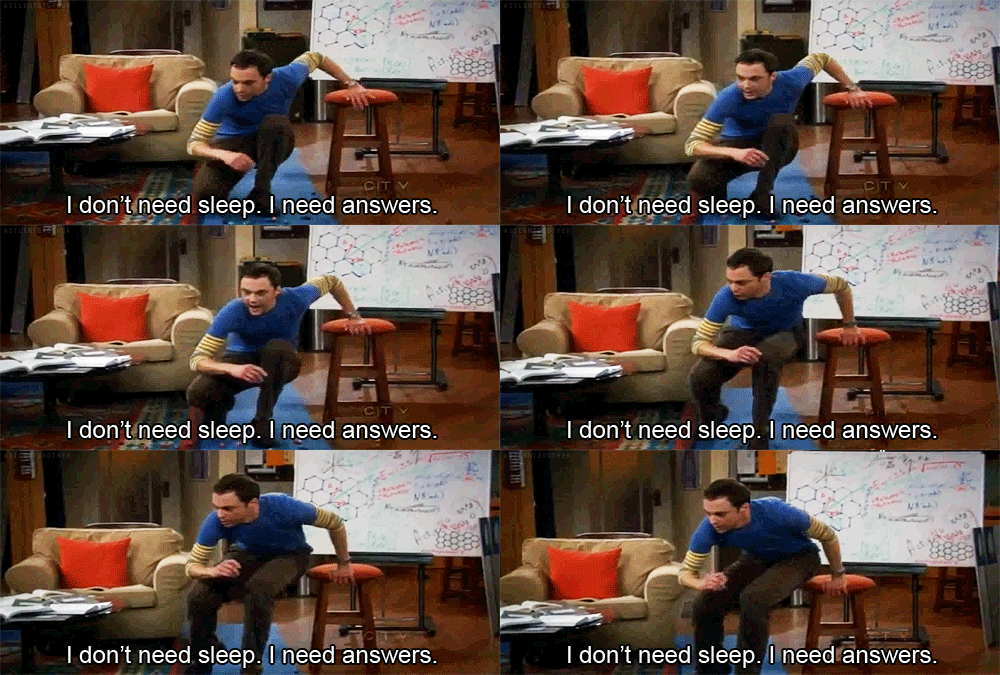
You see the above meme? (Sheldon from Big Bang
Theory). This was me this past week. When I need
answers while I'm doing my fun reading, I end up with a reading hangover the next day. What’s a reading
hangover, you ask? It’s the sluggish feeling you have the next day after
staying up too late instead of getting much needed sleep for work. Disclaimer:
reading hangovers only happen when a person stays up too late because of “fun
reading” (homework doesn’t count).
I am reading
the Outlander series and I finished reading Book 8 (Written in My Own Heart’s
Blood) today. This series deals with time travel (but not in a nerdy, technical,
sci-fi way) and this is what I've had to deal with and why I also need answers
at 1am....
**Some spoilers ahead**
Seriously, if
you have not read the first seven books, turn back now!
Don’t say I didn’t warn you…
*Claire Randall accidentally time travels from 1948 to 1743
*Claire travels back to 1948 to escape the Jacobite rebellion
*In 1968 Claire travels back to the 1760s to reunite with Jamie Fraser
*Her daughter Brianna travels back to the 1700s to be with Claire.
*Brianna's boyfriend, Roger, also travels back in time to the 1700s
*Now everyone is together in the mountains of NC
*Brianna and Roger have two kids but little Mandy is born with a heart defect so they must travel (backwards/forwards?) into the late 1970s so that Mandy can have surgery
So, in Book 8
Brianna and Roger’s son, Jem, gets kidnapped and Roger and Brianna think his
kidnapper has taken back to the 1700s so off Roger goes to the 1700s
*At this point the reader knows that Jem is still in 1980 but Brianna and the kids are separated from Roger by two centuries and this is WHERE I DON"T NEED SLEEP FOR WORK, I NEED ANSWERS!!!
*Roger ends up going
back too early and ends up in Scotland in 1739. He meets Jamie’s father, uncle
and sister before tragic things befell the Fraser clan. He knows what’s going
to happen to them but he can’t do anything about it or warn them because it
will change the future and how Jamie and Claire meet….
This series had been
on my to-read list for years- multiple people had recommended it to me but I
never found the time to tackle the series until the books were turned into a TV
show for the Starz network two years ago. I watched the first episode and was hooked;
I checked out the first book in the series (Outlander) was hooked on that as
well. Along with all the time traveling that keeps me up
at night, is some buried treasure (seriously), the American Revolution (the
battle scenes can get tedious if you’re not a fan of military science and
strategy), some Scottish/American culture and a bit of romance. The books are
HUGE (they are each approximately 800 pages)- they will make you laugh and cry.
Keep the tissues handy as well as Google Translate for the French, Gaelic, and
Latin phrases that are sprinkled throughout.
Sunday, May 14, 2017
The Last Girlfriend on Earth
Title: The Last Girlfriend on Earth
Author: Simon Rich
Genres: Short stories, humor, books on TV
I checked out this book after watching an episode of ManSeeking Woman. It’s a show where modern dating rules, anxieties, and conundrums are mixed
with the absurd. For example, in the episode I watched, one of the main
characters dates Santa Claus. This is not seen as ridiculous because everyone
believes in Santa Claus, he is a real person but it is scandalous- Santa is
married, after all. Other short stories were about a man who is engaged to Mother Teresa, a Jewish man whose ex-girlfriend is dating Adolf Hitler, and the title story about a man who is dating the last woman alive on Earth.
I normally don’t read short stories because a lot of short
stories leave a lot to be desired in my opinion or they end on a cliffhanger.
The short stories in The Last Girlfriend on Earth are mostly satisfying, snarky, and funny. There
were a few that left me with a Huh? feeling but I enjoyed most of the stories within the book. I will be adding Simon Rich's other works to my "to-be-read" pile.
Subscribe to:
Posts (Atom)